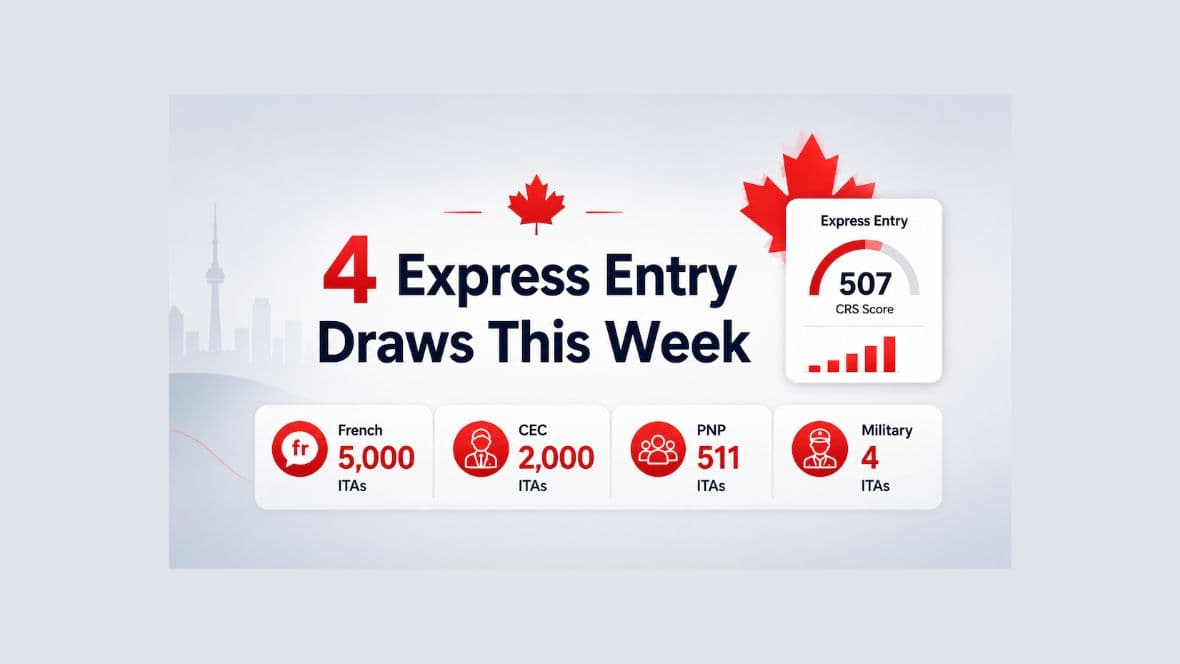



IRCC held a French-language proficiency draw today. This is the largest French draw yet, with 8,500 invitations issued. Candidates needed a CRS score of 400 or higher.
The CRS cutoff stayed nearly flat compared to the last French draw in December. If you have strong French skills, this is your best pathway to PR right now.
Draw Highlights
Here are the key details from today's French-language proficiency round:
- Category: French-Language proficiency (2026-Version 2)
- Invitations issued: 8,500
- Minimum CRS: 400
- Tie-breaking rule: February 03, 2026 at 11:11:44 UTC
- Date: February 6, 2026 at 11:38:00 UTC
Who was invited in this draw?
This was a category-based draw. IRCC only invited candidates with strong French language skills.
To qualify, you needed proven French proficiency. This typically means a TEF Canada or TCF Canada test. Your scores must meet minimum CLB levels in reading, writing, speaking, and listening.
You also needed a valid Express Entry profile. This can be under the Federal Skilled Worker, Canadian Experience Class, or Federal Skilled Trades program.
Category-based draws target specific skills Canada needs. French proficiency is one of six priority categories IRCC focuses on.
CRS score context and trend
The CRS cutoff increased by just 1 point from the last French draw. That draw happened on December 17, 2025, with a cutoff of 399.
A stable CRS around 400 is good news for French speakers. It means you don't need a sky-high score to get invited.
Compare this to general draws, which often require 500+ CRS points. French proficiency gives you a real advantage.
| Date | Program | ITAs | CRS |
|---|---|---|---|
| Feb 6, 2026 | French proficiency | 8,500 | 400 |
| Dec 17, 2025 | French proficiency | 6,000 | 399 |
| Nov 28, 2025 | French proficiency | 6,000 | 408 |
| Oct 29, 2025 | French proficiency | 6,000 | 416 |
The CRS has dropped 16 points since October 2025. The number of ITAs also jumped significantly this round.
What this draw means for candidates
- French speakers have a major edge. Your pathway to PR is faster and more reliable than general draws.
- IRCC increased the quota. Going from 6,000 to 8,500 ITAs shows strong demand for French-speaking immigrants.
- Draws happen roughly monthly. Based on recent patterns, expect another French draw in 4-6 weeks.
- Scores near 400 are competitive. If you're between 380-420, you have a real shot in upcoming draws.
- Bilingual candidates win. Strong English and French scores give you the highest CRS boost possible.
If you received an ITA: what to do next
You have 60 days to submit your full PR application. The clock starts today.
Gather these documents immediately:
- Valid passport (for you and all family members)
- Language test results (TEF Canada or TCF Canada for French, IELTS or CELPIP for English)
- Education credential assessment (ECA) from a designated organization
- Work reference letters with detailed job duties and dates
- Police certificates from every country where you lived 6+ months since age 18
- Proof of funds (if required for your program)
- Medical exam results (you'll get instructions after submitting)
Avoid these common mistakes:
- Using the wrong NOC or TEER code for your work experience
- Missing key job duties in reference letters
- Submitting expired language tests
- Incorrect employment dates or gaps
- Incomplete family information
Double-check everything before you hit submit. Errors can delay your application by months.
If you did not receive an ITA: next steps
Don't lose hope. You have several ways to improve your chances.
- Recalculate your CRS score. Update your profile as you gain work experience or if your spouse gets new credentials.
- Retake your language tests. Even small improvements in French or English can add 20-50 CRS points.
- Add French if you haven't already. This is the single best move for most candidates. Bilingual scores unlock category-based draws.
- Explore PNP options. A provincial nomination adds 600 CRS points. Use UmberApp's PNP Finder to see which programs match your profile.
- Get an ECA if you haven't. Your foreign education won't count toward CRS without it.
- Gain Canadian work experience. One year of skilled Canadian work opens the CEC pathway and boosts your score.
- Keep your profile active. Update it every time something changes. Inactive profiles get removed after 12 months.
How to increase your CRS score
Language tests are your biggest lever. Improving from CLB 7 to CLB 9 can add 50+ points. Study hard and retake the test.
Provincial nomination adds 600 points. This guarantees an ITA in the next general draw. Research PNPs that match your skills.
Job offers help sometimes. An LMIA-backed job offer adds 50-200 points. But most candidates don't need this if they have strong French.
Education upgrades matter. A master's degree adds more points than a bachelor's. Get your credentials assessed properly.
Spouse strategy counts. Sometimes switching who's the main applicant boosts your total score. Run both scenarios in a CRS calculator.
PNP options to consider right now
If your CRS is under 400, a provincial nomination might be faster than waiting for another French draw.
Ontario has strong French pathways. The OINP French-Speaking Skilled Worker stream targets bilingual candidates.
New Brunswick welcomes French speakers. Their streams prioritize Francophone immigrants with ties to the province.
Manitoba and Saskatchewan have active PNPs. Both provinces need skilled workers and process applications quickly.
Use UmberApp's PNP Finder. It matches your profile to programs where you're eligible. Check it today.
Visit our PNP Overview page for details on each province. Compare timelines, requirements, and success rates.
Need help with your Express Entry next steps? UmberApp can guide you through documents, timelines, and smart score improvements.